
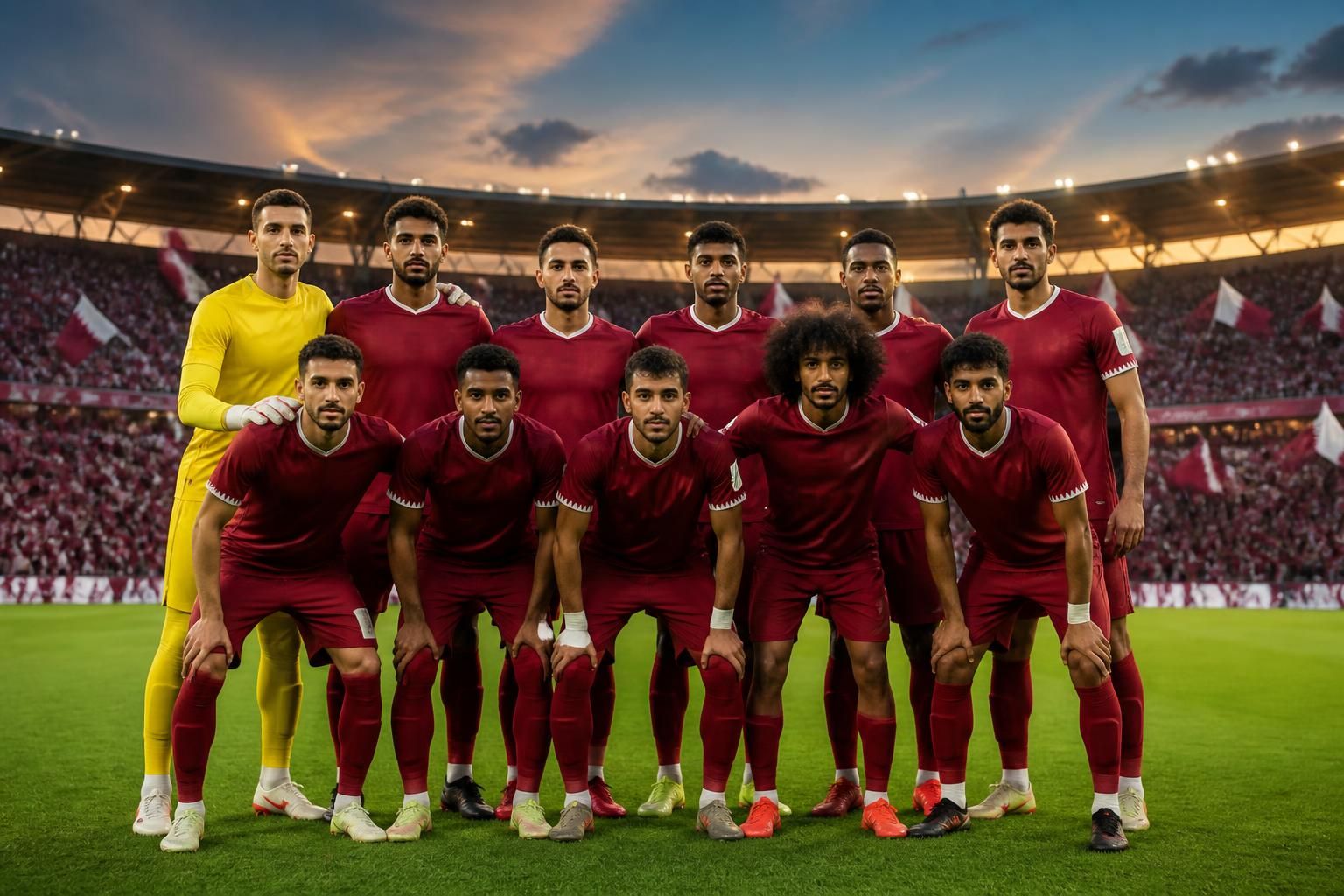
The anticipation builds as Qatar prepares to make its mark at the 2026 World Cup, coming off a less-than-stellar performance in 2022. Under the guidance of newly appointed coach Julen Lopetegui, the team’s 26-player squad combines domestic talents with experienced naturalized players, aiming to shift gears and compete more fiercely on the global football stage. Anchored by stalwarts like Almoez Ali, the national team’s all-time leading scorer, and the creative spark Akram Afif, Qatar sets out not just to participate but to challenge expectations in a tournament now expanded and hosted across North America. Facing a testing group that includes Switzerland, co-host Canada, and Bosnia and Herzegovina, the pressure is on for Qatar to evolve beyond their previous opening round exit. The blend of tactical discipline, cultivated over years despite regional challenges, signals a renewed commitment to strategic and cohesive play. Yet questions linger: can the Qatari squad, with a mix of youth and veterans, adapt swiftly to the rigors of international tournament pressure? As logistics and infrastructure improvements set the stage, and the wider World Cup format embraces expansion to 48 teams, Qatar’s journey mirrors a broader evolution in global soccer.
- 🌍 Qatar unveils a 26-player roster blending experience and youth under coach Julen Lopetegui.
- ⚽ Their group stage features tough clashes against Switzerland, host Canada, and Bosnia and Herzegovina.
- 🔥 Almoez Ali remains the key goal-scoring threat with Akram Afif as creative lynchpin.
- 🏟️ With enhanced infrastructure and a broader tournament format, Qatar aims for its first knockout stage.
- 🎯 Tactical discipline and regional experience underpin their strategic approach to this global soccer event.
Qatar’s 2026 World Cup team lineup: a blend of proven stars and emerging talent
Julen Lopetegui, who took the helm in mid-2025, has finalized a squad that signals clear intent to rewrite Qatar’s World Cup narrative. The squad is led by Hassan Al-Haydos, the captain and most capped player, backed up by trusted veterans like Boualem Khoukhi, who played every minute in the last tournament. The omission of older players like Sebastian Soria hints at a deliberate pivot towards agility and stamina, seeking a faster, more reactive team dynamic. With goalkeepers drawn from top domestic clubs such as Al-Duhail and Al Rayyan, and defenders and midfielders strategically sourced to balance defensive solidity with creative spark, the lineup reflects a cohesive national program. The attacking front leans heavily on the twin engine of Almoez Ali, who topped Asian qualifying charts with 12 goals, and Akram Afif, one of the continent’s most inventive wingers. These players provide a tangible connection between individual brilliance and team play, a combination Lopetegui hopes will translate into measurable success on the pitch.
Competition format and group stage hurdles for Qatar in 2026
Compared to 2022, the World Cup has evolved: the field has expanded to 48 teams, rearranging traditional competition dynamics and presenting a fresh tactical challenge. Qatar finds itself in Group B alongside Switzerland, Canada, and Bosnia and Herzegovina — a group that offers a mixture of physicality, home advantage for Canada, and European tactical discipline. Qatar kicks off its campaign in Santa Clara, California, facing Switzerland, a side known for its resilience and technical acumen, setting the stage for a high-stakes opener. These matchups underscore a tightrope walk for the Maroons; a mix of tactical flexibility and combativeness will be vital to navigate this stage. Qatar’s domestic preparation benefits from lessons learned in 2022, but the external pressures of travel, climate, and psychologically demanding fixtures remain key obstacles to overcome. As this World Cup unfolds across cities like Vancouver and Seattle — venues with distinct atmospheres compared to Qatar’s desert home turf — adaptability will be a decisive factor in their quest for progression.
Infrastructure and logistical transformations shaping Qatar’s 2026 World Cup experience
The handover from hosting a World Cup to preparing a team for a globally scattered tournament adds layers of complexity for Qatar. Unlike 2022, when matches were concentrated within Qatar’s compact geography, the 2026 edition’s North American spread challenges not only teams’ physical endurance but also their logistical planning. Qatar’s coaching and administrative staff face new demands, managing recovery times and travel between venues in the USA and Canada. This geographical shift underscores a broader FIFA strategy to globalize the tournament footprint, introducing varied climatic and cultural environments. This change could unearth both advantages and pitfalls for the Qatar squad, whose traditional strengths lie in controlled, familiar conditions. Yet this fresh landscape also presents an opportunity for Qatar to showcase its growing global football identity by responding creatively to new tactical and environmental demands — a journey mirrored in infrastructural investments occurring across World Cup host cities like Mexico City and Toronto.