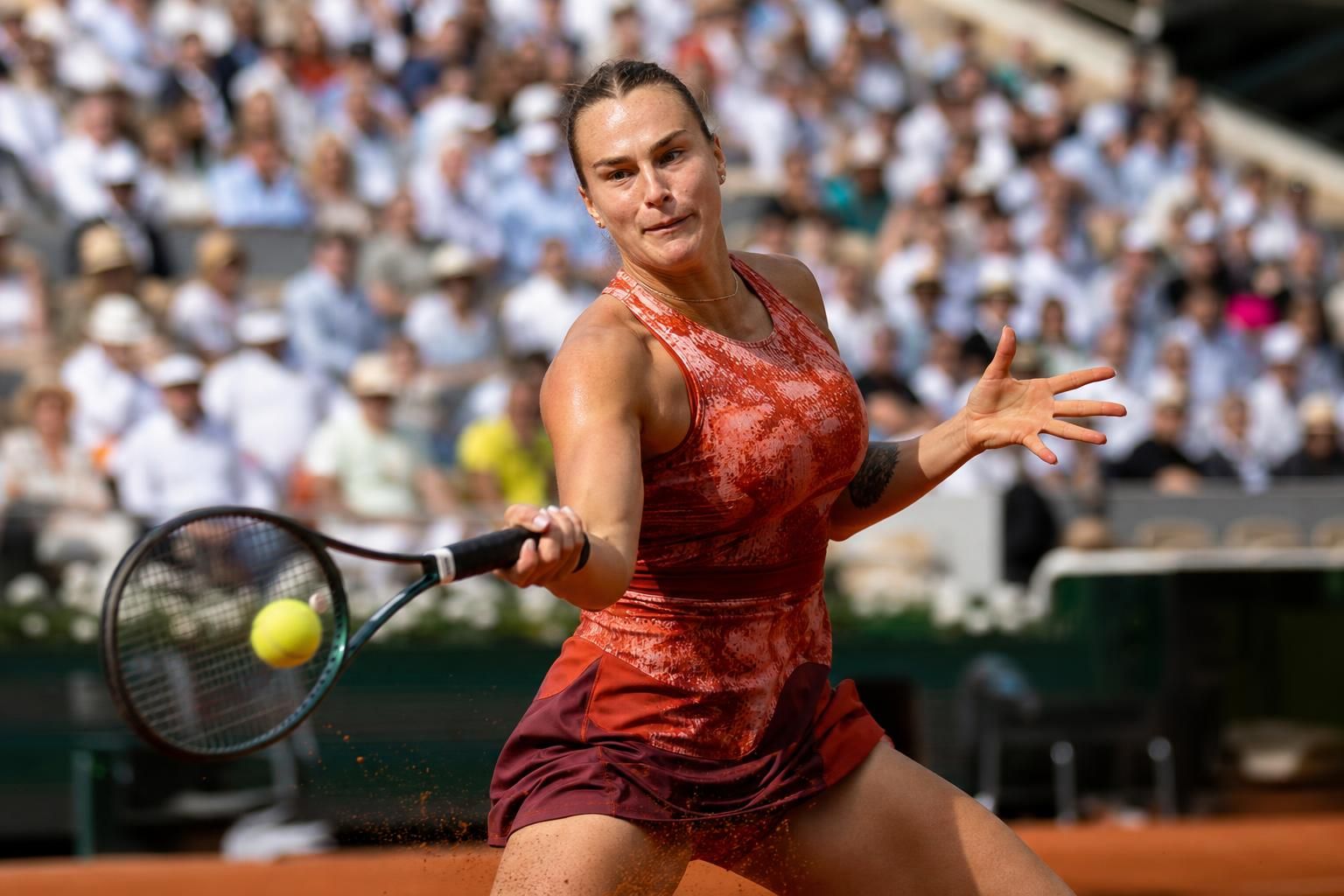
In the heart of Roland-Garros 2026, Aryna Sabalenka has once again proven why she is at the pinnacle of women’s tennis. Far beyond just her formidable game, her presence on the Court Philippe-Chatrier is marked by a unique blend of relentless skill and undeniable charisma. As the current World No. 1, she made a striking statement early in the tournament with a commanding victory over Spain’s Jessica Bouzas Maneiro, advancing confidently to the second round. Yet, it was not only her prowess that captivated the crowd and fans worldwide, but also an eye-catching display of style: Sabalenka wore a stunning piece of jewelry, a 75,000-dollar necklace embedded with over 200 carats of clay-hued garnets and 23 carats of diamonds, courtesy of New York’s luxury brand Material Good, for which she is an ambassador. This glittering accessory was no mere fashion choice—Sabalenka openly stated that feeling beautiful enhances her game, and she rigorously tested the necklace during practice to ensure it did not disrupt her performance.
Sabalenka’s choice to intertwine sportsmanship with style is not unprecedented but remains uniquely striking on the Grand Slam stage. From iconic Serena Williams sporting diamond-adorned bracelets in the early 2000s to Emma Raducanu’s elegant Tiffany & Co. accents, the tennis court is a showplace where athlete aesthetics meet competitive excellence. Sabalenka’s confidence, both in skill and in statement-making accessories, reflects an evolved approach to professional tennis, where personal expression enhances the athlete’s mindset as much as their tactical play. This dynamic was palpable at the French Open, where Sabalenka’s game sparkled as much as her jewelry under the bright Parisian sun.
Aryna Sabalenka’s Triumph at Roland-Garros: Blending Exceptional Skill with Charismatic Flair
At Roland-Garros 2026, Sabalenka’s multifaceted performance dazzled tennis enthusiasts globally. Dominating against Jessica Bouzas Maneiro with a 6-4, 6-2 win on the premier Philippe-Chatrier court, she displayed the power and precision expected from a top-ranked Grand Slam contender. Yet, it was not just the victory that garnered headlines, but her bold fashion choice—a necklace that mimics the very essence of the clay courts with its earthy garnets and sparkle of diamonds. This accessory, carefully selected alongside her coach and tested under practice conditions, symbolizes the convergence of athletic preparedness and personal branding.
Aryna’s ability to harness her sense of style as an additional layer of confidence illustrates a broader transformation in tennis culture. Here, athletes are not merely competitors but icons of style and charisma, inspiring fans both on and off the court. Sabalenka’s display challenges traditional norms about athlete presentation at Grand Slams, making her a true tennis star of both skill and personality.
The Impact of Sabalenka’s Unique Sportsmanship at French Open
Sabalenka’s approach offers a compelling narrative on how athletes blend competitive excellence with individuality. Her choice to wear high-value jewelry is a deliberate form of self-expression, demonstrating that confidence in appearance can enhance athletic performance. This modern perspective aligns with her recent dominating performances, including a significant breakthrough victory in the previous edition that challenged the reign of clay-court legend Iga Swiatek.
For audiences, Sabalenka’s charismatic aura brings an added layer of excitement to the sport, reminding us that tennis is as much about personality and presence as it is about physical skill. Her success underscores the evolving identity of a Grand Slam athlete — one who commands respect through precision and also captivates with personal flair.
Fashion Meets Finesse: The Rising Trend of Style in Grand Slam Tennis
The integration of luxury fashion into Grand Slam tournaments is becoming increasingly pronounced. Players like Sabalenka are at the forefront, embracing accessories that contribute to their mental preparedness. While some may critique such statements as distractions, the impact on Sabalenka’s game and sportsmanship tells a different story.
Wearing a necklace valued at $75,000 during a high-stakes match is not a trivial choice. It symbolizes a blend of heritage, personal identity, and psychological edge. This choice recalls moments from the past when Serena Williams and Emma Raducanu also employed stylish jewelry to bolster confidence and connect with their fans. This nuanced form of self-expression resonates with a new generation of tennis enthusiasts appreciating not only the scoreline but the persona on the court.
Moreover, Sabalenka’s disciplined routines—testing the jewelry in training to avoid distraction—highlight her professionalism and focus. It’s a clear message that style never compromises skill, but rather complements the holistic athlete experience on the international stage.
As we follow Roland-Garros and other elite tournaments, it becomes evident that players’ charisma and style are increasingly integral to their appeal, enhancing the sport’s visibility and fan engagement. For more insights into current developments in tennis, including notable tournament outcomes and player dynamics, the community can explore stories around major tennis withdrawals and emerging champions like Arthur Fils at Roland-Garros.